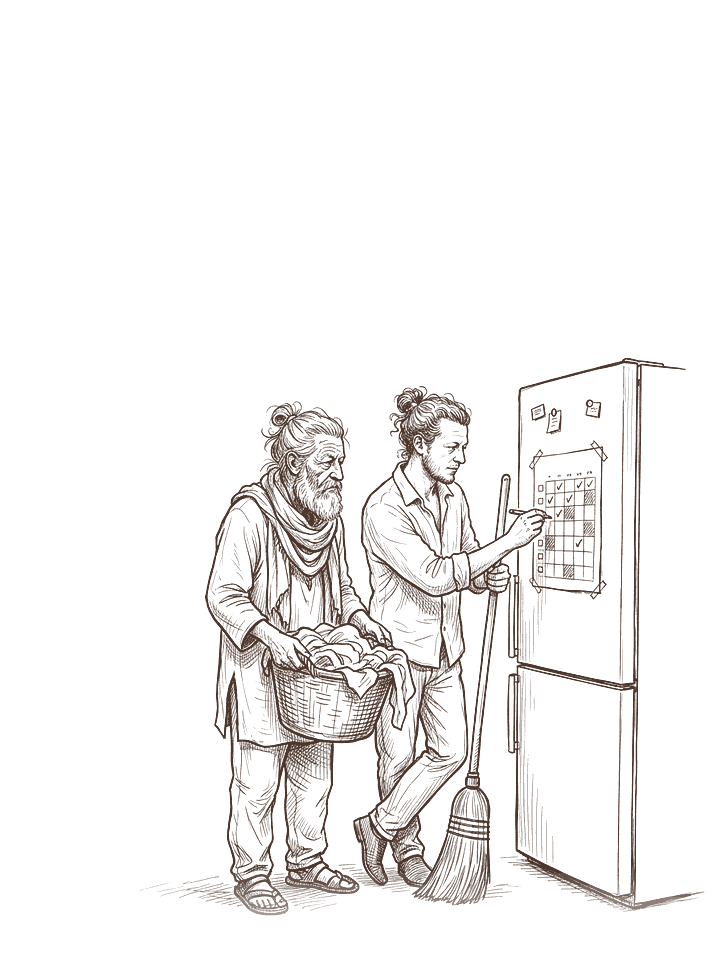
Start with work you can describe
Describe the work narrowly enough for people to discuss the same thing. “Look after the kitchen” could cover several jobs; “put the clean dishes away” gives the conversation a clearer starting point.
University of Minnesota Extension’s roommate guidance suggests talking about how household responsibilities will be divided. Its original audience is college students and other first-time roommates. We use that ordinary coordination idea here, not as evidence that a particular list fixes problems in every household.
Name the responsibility without assigning blame
Name the work before adding a person. Include preparation when everyone considers it part of the task. Use the description to clarify responsibility, rather than as an argument about who has done more.
If people understand the task differently, leave room to describe those differences. A polished chart is not a substitute for agreement.
Agree on what the entry means
Record the person who has agreed
Add a name only when that person has actually accepted the arrangement. An empty space does not mean the task defaults to whoever usually notices it.
If no arrangement has been reached, write “not agreed.” That keeps the open question visible without presenting an assumption as a decision.
Clarify what “done” means
Describe the result people have agreed to recognise. For dishes, that might mean returning the clean items to their usual places. It is an example to adapt, rather than a standard imposed on every household.
Keep the description short enough to use. If it turns into an inspection checklist, consider whether it still serves the arrangement you intended.
Add timing only where it matters
Some tasks have a relevant time because something else depends on them. Others can remain flexible. Record the distinction rather than giving every household action a fixed deadline.
The form does not decide how much work anyone should do or what division is fair. Those choices belong to the people involved and their circumstances.
Leave a way to change the arrangement
Agree how to propose a change before you need one. If someone becomes unavailable, a note such as “check before swapping” can preserve the next step you discussed. Writing a different name alone cannot transfer the responsibility.
Do not assume that handing over a task has been accepted because you wrote another name beside it. Keep uncertain changes marked as questions until they are agreed.
Choose where the current version lives
University of Georgia Extension’s time-management guidance includes shared household scheduling in an agreed place. Choose a location that works for the people using this sheet: paper, a shared note you already use, or another existing arrangement.
Choose the place people will actually consult, then make clear how a change is flagged. Paper and shared notes can both serve the purpose; the useful part is knowing which version records the current agreement.
Download the adult chore chart
The blank US Letter PDF is available immediately, with no email or household setup. Complete the rows together and voluntarily. It is a coordination note, not a contract or a test of a relationship.
Download the adult chore chart (PDF)
Each row is one agreed task. Leave the person field “not agreed” when no one has accepted it. Mark Done only when the agreed work is complete; an unchecked row is not a score or a debt.
| Task | Who | When | Done |
|---|---|---|---|
| ________ | ________ | ________ | □ |
| ________ | ________ | ________ | □ |
| ________ | ________ | ________ | □ |
| ________ | ________ | ________ | □ |
| ________ | ________ | ________ | □ |
Add a short note about what “done” means when a task needs it, any unresolved question and how you will propose a change. Agree where the current chart will stay. These notes belong to the people involved, rather than being instructions from the worksheet.
See the filled example PDF for illustrative entries, not suggested assignments. You can print the blank PDF or this page. The printable chart page also provides fields you can fill in before printing, plus Print and the same downloads. Typed entries are not saved or sent; print the completed page before leaving if you want to keep them.
Keep unfinished agreements visible without turning them into a score. If the difficulty is a conflict between people, a task sheet alone cannot resolve it. This guide does not offer relationship therapy or a method for making someone cooperate.
Keep your personal preparation separate
If a task you agreed to take on involves an ordinary item for tomorrow, My Week has a corresponding preparation action. Choose the evenings focus and use Swap to select “Prepare one thing for tomorrow.”
Use My Week for your own preparation when it fits the task you accepted. Keep the household agreement where everyone chose to keep it. My Week cannot assign work to others, synchronise a household calendar or send household reminders.
Frequently asked questions
How do you divide household chores?
The page gives no ratio or rule. It suggests talking about how household responsibilities will be divided, naming the work before adding a person, and adding a name only when that person has actually accepted the arrangement. The form does not decide how much work anyone should do or what division is fair.
Is there a printable chore chart for adults?
Yes. The blank US Letter PDF is available immediately, with no email or household setup, and a filled example PDF shows illustrative entries, not suggested assignments. Complete the rows together and voluntarily. It is a coordination note, not a contract or a test of a relationship.
What if we disagree about what counts as done?
Describe the result people have agreed to recognise; for dishes, returning the clean items to their usual places is an example to adapt. If people understand the task differently, leave room to describe those differences. A polished chart is not a substitute for agreement, and a task sheet alone cannot resolve a conflict between people.
Does every task have to be split equally?
The sheet does not define fairness. Record the arrangement participants actually agree to, without a universal ratio or score.
What if nobody has agreed to a task?
Write “not agreed” and keep the question visible. Do not assign it by default to another person.
Can roommates use the sheet?
Yes, as an optional coordination note. The linked Minnesota Extension material discusses household responsibilities in a roommate setting; it does not validate this particular form.
Does My Week share this list with my household?
No. Keep the shared record separately. My Week offers individual preparation actions, not household task assignment or synchronization.