Sencha is made from new shoots that are steamed, rolled and dried. Gyokuro is also steamed, rolled and dried, but the plants are covered to restrict direct sunlight for roughly twenty days before picking. Matcha starts as tencha — leaves from covered fields, steamed and dried without rolling — which is then milled into powder. Sencha and gyokuro are leaves to infuse and strain; matcha is powder mixed into the drink.
Before comparing prices or tasting notes, separate what you will do with these three teas. Sencha and gyokuro are leaves to infuse and strain; matcha is powder mixed into the drink. Follow those different routes through cultivation, manufacture and preparation to make the shelf labels more useful.
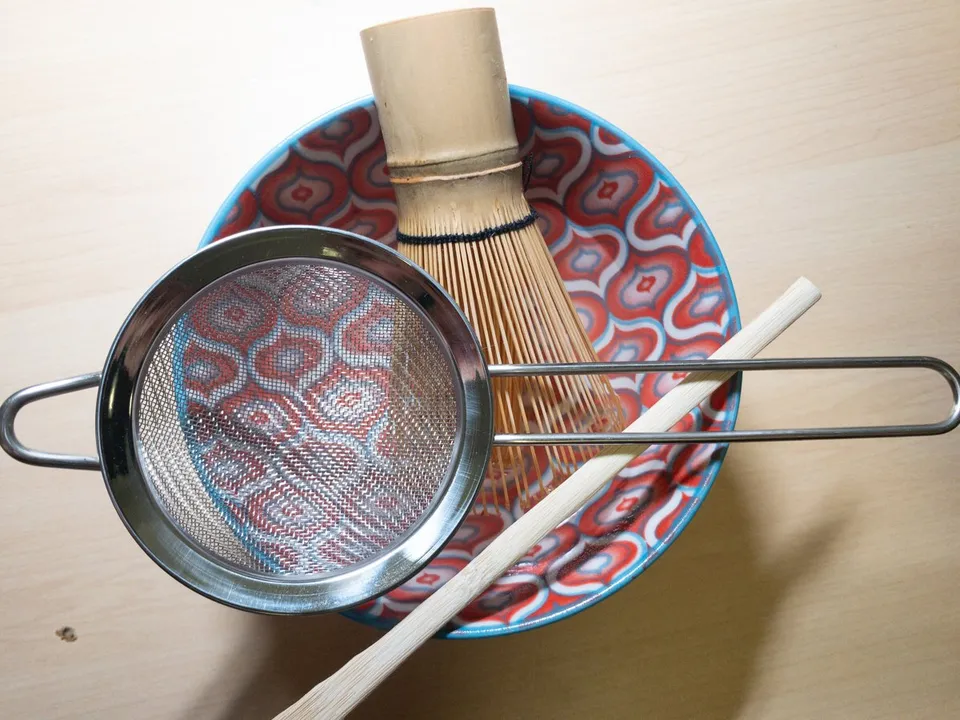
Tools for preparing matcha, identified by the photographer. Equipment context rather than evidence about a particular tea or producer.
Tools to make matcha — Akp1435. CC BY 4.0. Proportional resizing and WebP conversion; no crop or retouching. The original licence also applies to these derivatives.
Sencha: steamed, rolled and dried
Japan’s Ministry of Agriculture, Forestry and Fisheries describes sencha through its basic sequence: new shoots are steamed, rolled and dried.[1] Chinese Longjing, by contrast, gets its flat leaves from pan-processing. In the Kyoto Prefectural Tea Industry Chamber’s manufacturing account, successive stages work moisture through the leaf and progressively shape it, including a stage that forms slender needles.[2]
Sencha is often introduced as sun-grown tea. That is a helpful broad contrast with gyokuro, but “sencha is never shaded” is too rigid. The Kyoto chamber notes that some sencha receives short periods of covering. It also distinguishes deeply steamed sencha, showing that the category contains variations in manufacture as well as cultivation.[3]
Ask which sencha the packet contains. Producer, cultivar, harvest and steaming details give you a description you can return to after a good cup. You need not collect every detail before drinking, but an elaborate name alone is hard to use for a repeat purchase.
Gyokuro: shading changes the starting material
Gyokuro’s distinguishing cultivation step happens before picking, when the plants are covered to restrict direct sunlight. MAFF describes a covering period of approximately twenty days, followed by steaming, rolling and drying.[1] Treat that duration as a description of the method, rather than a universal timer that lets you classify any unfamiliar tea by counting days.
The leaf is still prepared for infusion. Gyokuro does not become matcha simply because both involve shading. Its production follows the rolled-leaf route, whereas the raw material for matcha follows a different drying route.[1]
Keep serving size beside concentration when reading gyokuro directions. The Kyoto chamber uses less water and a cooler preparation than in its sencha guidance.[4] Read those amounts as their own method, not as instructions for your usual large mug.
Matcha begins with tencha
Tencha is the leaf material used to make matcha. MAFF describes leaves from covered tea fields being steamed and dried without rolling, then milled to a fine powder.[1] In the Kyoto production account, the leaves are spread and dried open, and stems are separated during processing.[2] This is a distinct manufacturing path, not simply an extra grinding step added to finished sencha.
The Kyoto chamber’s definitions explicitly distinguish powdered tencha, called matcha, from other powdered teas. It also explains that modern grinding equipment can produce matcha; a traditional stone mill is not the only equipment covered by its definition.[3] “Stone-ground” may describe a particular product, but the absence of those words does not settle what the powder is.
Read the ingredients before deciding how to prepare the product. Pure matcha, a blend containing matcha and a sweetened drink mix are different purchases, with different amounts of tea and different instructions.
Infusing leaves and whisking powder
With sencha and gyokuro, the usual task is to extract a drink from the leaves and separate the liquid from them. With matcha, fine leaf material is dispersed into the water and remains in what you drink. This is why “leave it to steep and strain” is the wrong starting instruction for a bowl of matcha.
For matcha, the Kyoto chamber lists a bowl, whisk and sieve, and describes first mixing the powder into the water before whisking back and forth.[4] Sifting and mixing deserve attention before you judge a powder’s taste: dry lumps are a preparation problem you can investigate separately from whether you enjoy the tea.
Try three preparations, not one recipe
For an introduction, choose one clearly identified sample of each and prepare each in its own way. Equal leaf amounts, water and timing would not make this a fair ranking of three different methods.
Copy each supplier’s instructions onto a card. Include the actual water volume, since a recipe for a few small servings can be misleading when read as one mug.
Prepare the sencha in a pot or infuser that lets you remove the leaves. Record how much liquid you pour out.
Prepare the gyokuro according to its own directions. Use a small cup so that you can consider texture and concentration without expecting a large serving.
Sift and whisk the matcha according to its instructions. Check for unmixed powder before deciding you dislike its texture.
Write one useful distinction for each: something about aroma, mouthfeel, serving size or the work of preparing it.
Use the comparison to choose a preparation for an occasion and one detail to adjust next time. It is a guided tasting, not a laboratory ranking; different packets, water and preferences can lead to different choices.
From Pavel’s tea table
Personal experience — Pavel Rachkouski, founder. One person’s notes, not advice.
I’ve had matcha, a nice one that brews properly, but never sencha. Japanese tea as such never stuck with me; I didn’t pay it much attention.
Frequently asked questions
Are sencha and matcha the same?
No. Sencha and gyokuro are leaves to infuse and strain; matcha is powder mixed into the drink. Sencha is made from new shoots that are steamed, rolled and dried. Matcha starts as tencha — leaves from covered fields, steamed and dried without rolling — which is then milled into powder.
What is the difference between matcha and other green tea?
Matcha is made from tencha: leaves from covered tea fields that are steamed and dried without rolling, then milled into powder that stays in the drink. Leaf green teas such as sencha and gyokuro are steamed, rolled and dried, then infused and strained. That is why “steep and strain” is the wrong starting instruction for matcha.
Is matcha just ground sencha?
No. Matcha is made from tencha, leaves from covered tea fields that are steamed and dried without rolling, then milled. It is a separate manufacturing path, not an extra grinding step added to finished sencha.
Is all sencha unshaded?
Not always. The Kyoto tea chamber notes that some sencha receives short periods of covering, and it distinguishes deeply steamed sencha as another variation.
How is gyokuro brewed differently from sencha?
The Kyoto chamber’s guidance uses less water and a cooler preparation for gyokuro than for sencha. Read those amounts as their own method and follow the directions for your tea.
What temperature should sencha be brewed at?
In the Kyoto Prefectural Tea Industry Chamber’s sencha method, boiled water is cooled to about 70–80°C before it goes into the pot, and the tea infuses for about 45 seconds to 1 minute.[4] Read those amounts as their own method and follow the directions for your tea.
Can you steep sencha twice?
Yes. In the same Kyoto chamber method, the second and later infusions use slightly hotter water and a shorter wait, and each infusion is poured out to the last drop.[4]
Why is my sencha yellow?
A yellowish cup can be normal for sencha. The UK Tea & Infusions Association describes sencha’s dark green flat needles as giving a pale yellow infusion with a light, delicate flavour.[5] Kyoto’s tea chamber describes the leaves in the pot absorbing the hot water and turning yellow-green while sencha infuses for about 45 seconds to 1 minute.[4]
Does matcha have to be stone-ground?
No. The Kyoto chamber explains that modern grinding equipment can produce matcha. “Stone-ground” may describe a particular product, but its absence does not settle what the powder is.
Is sencha the same as green tea?
Sencha is one kind of green tea, not a separate category. Japan’s Ministry of Agriculture, Forestry and Fisheries lists it first among the main Japanese green teas, calls it the most commonly drunk, and describes it as new shoots steamed, rolled and dried. Gyokuro, kabusecha, tamaryokucha and tencha, the leaf ground into matcha, are other green teas on the same list.[1]
Does sencha have caffeine?
Yes. Japan’s Ministry of Health, Labour and Welfare, citing the national food composition tables, gives about 20 mg of caffeine per 100 ml for sencha brewed with 10 g of leaf in 430 ml of water at 90 °C for one minute, against about 60 mg per 100 ml for coffee brewed with 10 g of ground coffee in 150 ml of boiling water.[6] Those figures describe that brewing method; your own cup depends on how much leaf you use, the water and the time.
Sources
[1] Japan Ministry of Agriculture, Forestry and Fisheries, What types of green tea are there?, definitions of sencha, tencha and gyokuro; Japanese.
[2] Kyoto Prefectural Tea Industry Chamber, Tea manufacturing method, tencha, sencha and gyokuro production.
[3] Kyoto Prefectural Tea Industry Chamber, Types of tea, drawing on Japan Tea Association naming definitions.
[6] Japan Ministry of Health, Labour and Welfare, Q&A on excessive caffeine intake from food, table “Caffeine concentration in foods”, citing the Standard Tables of Food Composition in Japan 2015 (7th revised edition); Japanese. Checked 14 November 2026.