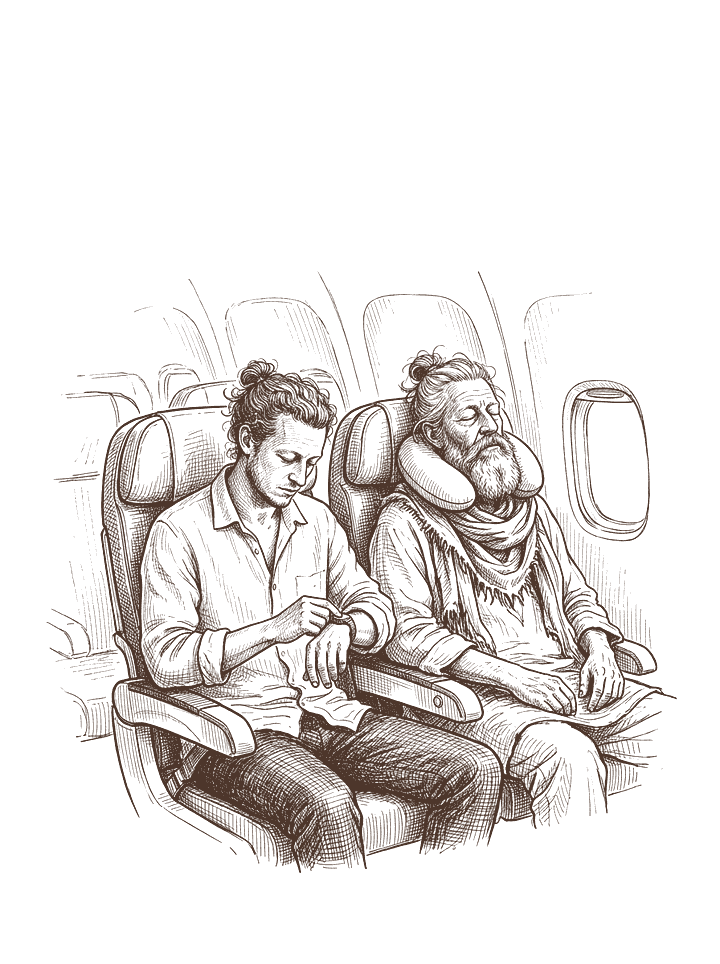
Jet lag happens when your internal body clock and the new local time are temporarily out of step, which can affect sleep, daytime alertness and concentration. To plan around it, give yourself enough time to sleep before departure, put arrival and the first commitments on the same itinerary in destination time, and, if practical, move bedtime and waking time toward the destination’s schedule over the preceding days. Eastward travel often means moving sleep earlier; westward travel, later.
Your watch changes to local time immediately; your sleep timing may not. Put arrival and the first commitments on the same itinerary in destination time, then look for the sleep opportunities between them. This gives you choices to prepare without predicting how quickly you will adjust.
The worksheet follows an occasional adult trip through departure, transit, arrival and return. Use it to separate what you can arrange from what the journey may disrupt.
Understand what changes
Jet lag happens when your internal body clock and the new local time are temporarily out of step. It can affect sleep, daytime alertness and concentration. Lost sleep during travel can add to the difficulty. The size and direction of the time change, as well as individual differences, matter. Eastward travel often involves moving sleep earlier; westward travel involves moving it later. People commonly find the latter easier, but that is not a prediction for your trip. CDC Yellow Book explains the distinction.
Before departure, protect sleep opportunities
Write a local date and time for every flight, connection and arrival. Then check the time difference for those dates. A difference remembered from another season can give the whole worksheet the wrong starting point.
Give yourself enough time to sleep before departure. If practical, you could begin moving bedtime and waking time toward the destination’s schedule over the preceding days. NHS guidance supports rest before travel and this optional adjustment. Work, caring responsibilities or an early departure may limit what is possible.
Look at the amount of sleep opportunity as well as the clock time. A later bedtime with the same early alarm shortens the window. NHLBI’s guidance emphasizes making enough time for sleep; changing the timetable should not hide that loss.
If arrangements are flexible, consider arriving before an important commitment. The CDC’s traveller guidance suggests allowing at least two days before important events. That is a planning option, not a guarantee of adjustment or a requirement to buy extra nights.
During the journey, use destination time as a reference
Mark the journey periods that fall during night at the destination. NHS suggests trying to sleep then. Treat those periods as opportunities: a connection, cabin service or simply being unable to sleep may interrupt them, so the full flight time is not a sleep total.
Keep water available and avoid excess alcohol. If you use caffeine, consider the next intended sleep period: its effects can last for hours and interfere with sleep. NHLBI explains this effect. A coffee bought in an airport’s morning may fall near the destination’s bedtime.
After arrival, allow a workable transition
For a longer stay, the practical aim is sleep and waking times that fit the destination. Light exposure is more complicated than “get some morning light”: its effect depends on timing, the route and the time difference. The CDC Yellow Book explains that complexity; this worksheet does not prescribe bright-light sessions.
The sources differ on naps: NHS advises avoiding daytime sleep, while the CDC traveller page allows a short nap when sleepy. Keep that difference visible instead of turning either into a test of staying awake. A long daytime sleep can interfere with the next night.
If sleepy, do not drive or do hazardous work to meet your planned schedule. Change the activity or arrange another way to travel. NHLBI describes how insufficient sleep impairs reactions and driving. A nap is not proof that you are ready to drive.
Check whether a short stay needs a different plan
For a very short visit, consider whether changing schedules twice fits the trip. NHS suggests considering home eating and sleeping times for a two- to three-day stay. Translate them into destination time first, then compare them with the responsibilities you actually have; they are an option, not an instruction to ignore those commitments.
Your travel sleep planning worksheet
Copy this original worksheet into your itinerary. Fill times with a date and a named time zone; keep unanswered questions visible.
| Stage | What to record |
|---|---|
| Before | Destination and travel dates: ___. Time difference on those dates: ___. Length of stay: ___. |
| Before | First important commitment in destination time: ___. Is an earlier arrival possible? ___. |
| Before | Sleep opportunity before departure: ___. What would unnecessarily shorten it? ___. |
| In transit | Journey periods that overlap with destination night: ___. Connections or duties that interrupt them: ___. |
| On arrival | Intended local sleep and waking times: ___. What remains flexible if the journey goes badly? ___. |
| On arrival | Transport or demanding activity to change if sleepy: ___. Alternative: ___. |
| Return | Return arrival and first commitment: ___. What needs its own plan? ___. |
A worked example
An illustrative traveller has a seven-night stay five hours ahead of home. Arrival is Monday at 09:00 local, equivalent to 04:00 at home. The first important meeting is Wednesday at 10:00 local.
In this example, the traveller records the overnight flight as a possible sleep window and marks the interrupting connection. Monday’s optional sightseeing stays flexible, and transport does not require driving. The worksheet identifies choices rather than predicting sleep. A separate return row deals with the change on the journey home.
If jet lag is difficult to manage, discuss it with a healthcare professional, as the CDC advises. Bring the itinerary and describe what actually happened, rather than treating the worksheet as a diagnosis.
From Pavel’s experience
Personal experience — Pavel Rachkouski, founder. One person’s notes, not advice.
When I move and get used to a new place, at some point, about two weeks in, insomnia starts. There have been nights I couldn’t sleep at all and went walking around Dubai, around Turkey. My sleep has changed over the years.
On a plane I don’t sleep; I only drop off if it really knocks me out. Usually I read books or watch films; that can send me to sleep, but as a rule not for long.
Frequently asked questions
Why is jet lag often worse going east?
Eastward travel often involves moving sleep earlier and westward travel moving it later. The CDC Yellow Book explains that for most people it is easier to shift the body clock later than earlier, because the internal circadian rhythm runs slightly longer than 24 hours on average; it gives an average adaptation of about 1.5 hours a day after westward travel and 1 hour a day after eastward travel. That is not a prediction for your trip.
Should I change my sleep schedule before flying?
If practical, you could begin moving bedtime and waking time toward the destination’s schedule over the preceding days; NHS guidance supports rest before travel and this optional adjustment.