A sleep article may use “duration,” “quality,” “deep sleep” and “body clock” as if their differences were obvious. They name different parts of the picture. Understanding those differences helps you follow the explanation without measuring every part of the night.
Begin with the question behind the word. “How long?” concerns duration; “when?” concerns timing; “how did it feel?” calls for another description. The sections below keep those questions distinct as they explain sleep, waking and the stages within a night.
Common sleep terms in one line each:
- Sleep duration — time actually asleep, not time in bed.
- Time in bed — the whole window from getting into bed to getting up, including time awake.
- Sleep quality — how well you sleep, including how refreshing and uninterrupted it feels.
- Sleep timing — when sleep happens, for example overnight or after a night shift.
- Circadian rhythm — the body’s roughly 24-hour internal clock, set partly by light and dark.
- Sleep pressure — the need for sleep that builds the longer you are awake.
- Sleep stages — the parts of a night: non-REM stages (light to deep sleep) and REM sleep.
Sleep duration and time in bed
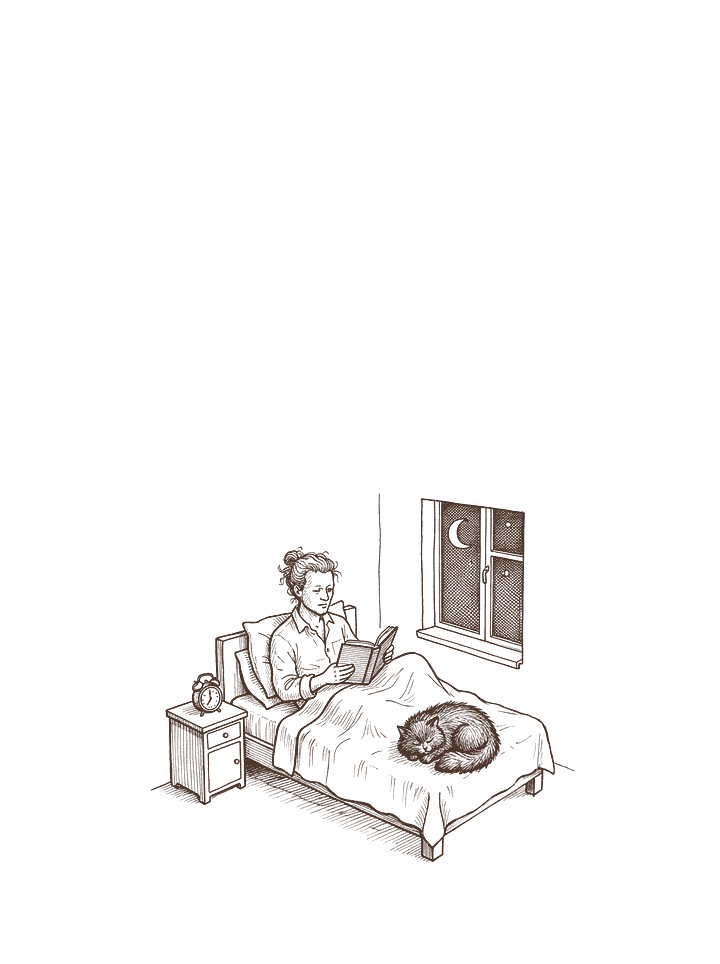
Sleep duration means time spent asleep. In ordinary conversation, time in bed includes time when you were awake as well. Reading a chapter before trying to sleep belongs to the latter description; it is not automatically sleep.
For example, “in bed from eleven until seven” describes a window, not eight measured hours of sleep. The time before falling asleep and any waking within that window still matter. When reading a study or questionnaire, check where its authors start and stop the measurement.
Sleep quality describes how well you sleep
Sleep quality concerns how well you sleep, including how refreshing and uninterrupted it is. CDC distinguishes this from the number of hours slept. A duration alone therefore leaves part of the picture unexplained. CDC explains sleep quality.
Give “quality” a concrete description when you can. “I remember waking several times and felt sleepy in the meeting” communicates more than a rating alone. It describes an experience while leaving its cause open.
Duration and quality belong together in a description. Neither label, by itself, explains why you feel a particular way.
Sleep timing and your body clock
Sleep timing describes when sleep happens. Someone sleeping around a night shift and someone sleeping overnight may sleep for similar amounts at different times. Duration answers “how long”; timing answers “when.”
Your circadian rhythm is an approximately 24-hour biological pattern associated with internal body clocks. Light and darkness help synchronize those clocks with the environment. People can differ in their natural timing: some tend to wake earlier and others later. NHLBI explains the sleep/wake cycle.
Sleep pressure is an everyday name for the biological need for sleep that builds during wakefulness. This and circadian timing help explain sleep regulation from different angles: how long you have been awake, and where you are in the daily rhythm. Knowing these terms does not identify a personally suitable bedtime.
Sleep cycles and sleep stages
Within a night, sleep moves through a repeating sequence of phases. That sequence is a sleep cycle. Keep it separate from the roughly daily rhythm of the body clock; NHLBI’s overview explains the pattern within sleep.
The two broad phases are non-REM and REM, short for rapid eye movement. Non-REM contains three stages:
- Stage 1: the transition from wakefulness into sleep.
- Stage 2: you are asleep; this stage is distinct from deep non-REM sleep.
- Stage 3: also called deep sleep or slow-wave sleep, named for a pattern of brain activity.
During REM sleep, the brain is active, the eyes move rapidly and muscles normally become limp. Dreaming usually occurs during this phase. Deep sleep generally occupies more of the earlier night, while REM is more prominent later. Stages are identified using physiological measurements, including brain activity. NHLBI describes sleep phases and stages.
Read the stage numbers as labels, not places in a league table. Deep sleep and REM describe different stages; neither stands for everything that makes up a good night.
Sleep onset and awakenings
Sleep onset means the beginning of sleep. Sleep-onset latency, often shortened to sleep latency, concerns the time it takes to fall asleep. NHLBI describes sleep latency testing as measuring how quickly a person falls asleep during daytime nap opportunities. The glossary term itself does not specify a desirable number of minutes. NHLBI explains sleep studies.
An awakening is a return to wakefulness after sleep has begun. NHLBI notes that brief waking can happen between cycles. That is different from the initial process of falling asleep. Describing which part of the night you mean makes a question clearer.
A quick reference for reading about sleep
| If the question is about… | The relevant term is… |
|---|---|
| How much time was spent asleep | Duration |
| When sleep occurred | Timing |
| How refreshing or interrupted sleep felt | Quality |
| The body’s roughly daily rhythm | Circadian rhythm |
| Time taken to fall asleep | Sleep-onset latency |
| Returning to wakefulness after sleeping | Awakening |
| The repeating sequence within sleep | Sleep cycle |
Turn a term into a useful question
Keep the wording you encountered, where it appeared and what you want explained. For example:
- Term: “Sleep cycle.”
- Where I saw it: An article discussing sleep stages.
- Question: “Does the author mean the sequence within a night, or the daily sleep/wake rhythm?”
You can also ask, “By duration, do you mean time asleep or the time between bed and getting up?” Plain words are enough. Use the glossary to make the question clearer, rather than choosing a technical label before you know what it means.
For regular problems sleeping, CDC advises speaking with a healthcare provider. Bring your question and observations; this glossary provides vocabulary rather than an explanation of your individual sleep.
From Pavel’s experience
Personal experience — Pavel Rachkouski, founder. One person’s notes, not advice.
As a kid I watched a sci-fi film, and about once every five years I dream the same scene: a liquid-metal robot is chasing me and I can’t get away. Then a second one appears and starts saving me, I realise it’s the plot of the film, and I wake up. The last time was a few years ago, exactly like in childhood.
Otherwise I don’t dream often. I mostly dream when I’m anxious or stressed: that I’ve lost my passport, that kind of thing.
Frequently asked questions
What does sleep continuity mean?
How unbroken sleep is once it has started. Researchers often describe it with wake after sleep onset, the minutes spent awake during the sleep period, and with sleep efficiency, the proportion of that period spent sleeping.
What is the difference between time in bed and sleep duration?
Time in bed counts everything from lying down to getting up; sleep duration counts only the time asleep. Reading in bed or lying awake is time in bed, not sleep.
What does “sleep quality” mean?
It describes how well you slept — whether sleep felt refreshing and how often it was interrupted — rather than how many hours it lasted.
What is a sleep cycle?
During a night, sleep moves through non-REM and REM stages in repeating cycles. The number and length of cycles vary between people and nights.
What is deep sleep?
The deepest stage of non-REM sleep, sometimes called slow-wave sleep. A sleep study records brain activity and other signals to identify sleep stages; a consumer tracker gives a stage estimate, which is not a diagnosis. See how to choose a sleep tracker.
Prepared with AI assistance. The source comparison recorded for 16 October 2026 was AI-assisted; it was not an independent human fact-check or medical review.