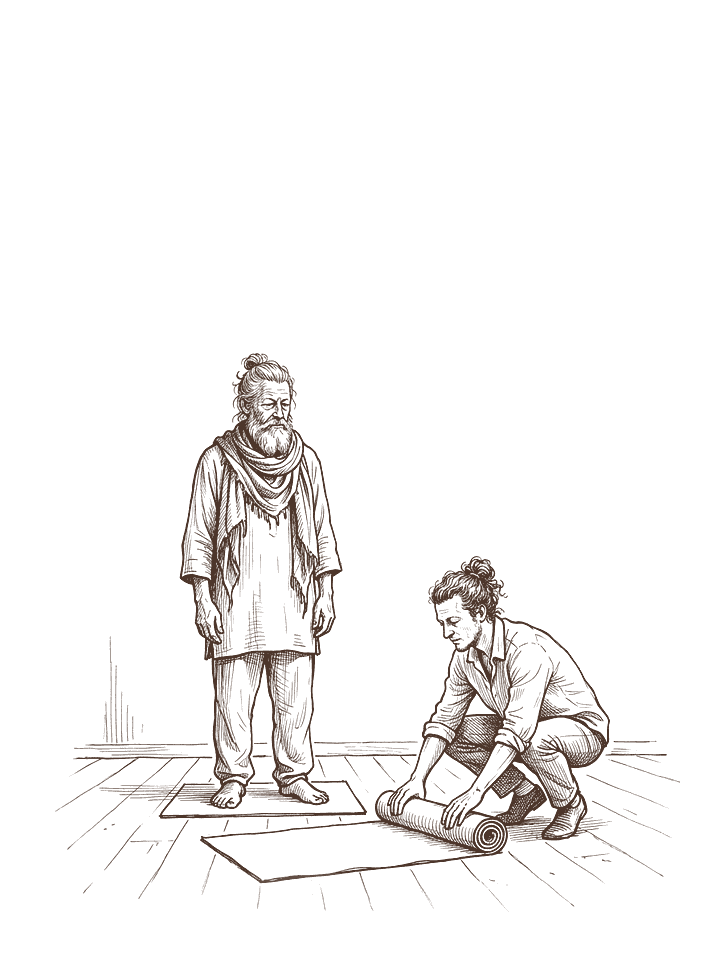
Hatha yoga has two related meanings. Historically, it refers to a broad family of practices that emerged among diverse Indian ascetic traditions around 1000 CE, according to the SOAS Hatha Yoga Project. On a modern studio timetable, “Hatha” often means a class that spends time on individual postures. The timetable is not a promise to reproduce the whole historical tradition, so read the description beside the name.
When a timetable says Hatha, read the description beside the name. Historically, hatha refers to a broad family of practices; in a studio, it often means a class that spends time on individual postures. The two uses are related, but the timetable is not a promise to reproduce the whole historical tradition.
A broad historical family
The SOAS Hatha Yoga Project places the emergence of Hatha among diverse Indian ascetic traditions around 1000 CE. Its research describes a changing practice that crossed religious boundaries, rather than a single system created by one founder. Many forms of modern yoga draw on this history. SOAS Hatha Yoga Project
Premodern Hatha included much more than familiar standing and seated poses. Breath practices and bodily techniques called mudras were important, and the goals and explanations varied between texts. The historical picture therefore needs more room than the modern shorthand “physical yoga” allows. Birch: Early Hatha texts and their practices
A major later text, the fifteenth-century Hatha Pradipika, brought together earlier teachings. Sanskrit scholar Jason Birch also distinguishes the ordinary meaning of hatha, associated with force, from its symbolic explanation through the sun and moon. That symbolism belongs to the tradition, but it is not a straightforward literal translation of the word. Neither interpretation is an instruction to force a posture. Birch, The Meaning of hatha in Early Hathayoga
What a Hatha class commonly means today
The British Wheel of Yoga describes a contemporary Hatha class as involving postures, often alongside breathing, guided meditation and a closing relaxation. It also uses Hatha as an umbrella term for several physically based approaches. This explains why one teacher may call their entire practice Hatha while a studio uses the same word for one specific class on its schedule. British Wheel of Yoga
In that narrower timetable sense, expect more opportunity to settle into a posture and listen to instructions than in a continuously flowing session. USC’s yoga program describes its Hatha offering in those terms. This is a useful example of current usage, rather than a rule that every teacher follows. USC yoga style guide
Find out how the teacher uses that time. The sequence may change each week, with demonstrations, repeated postures or movement between holds. The name alone cannot tell you the demands of the class, the amount of floor work or the length of a hold; the description and level should add those details.
Props and teaching emphasis
Ask about equipment separately: which blocks, belts, blankets or chairs are used, and how are the options explained? A Hatha class can use many props or very few. That detail helps you picture the setup, but it still leaves the teaching itself to discuss.
Then ask how the session divides its time among postures, breathing, meditation and discussion. If your aim is to learn unfamiliar shapes, make that clear: “Do you demonstrate and explain the poses?” is a more answerable question than “Is this easy?”
Questions worth asking
- When you call this class Hatha, what pace and structure do you mean?
- Does it follow a particular school, or your own combination of approaches?
- Are postures introduced individually, or is familiarity assumed?
- How are props and alternatives incorporated into the class?