By Pavel Rachkouski · Prepared with AI assistance.
Yoga style names on a timetable describe different kinds of things. Hatha names a broad historical family of practices; Ashtanga Vinyasa and Iyengar are teaching schools linked to particular teachers; Vinyasa, Yin and restorative describe how a class is paced or supported; hot yoga describes the room. Paths such as bhakti, jnana, karma and raja yoga are spiritual orientations, not sequences of postures. Yoga developed in South Asia and its meanings have changed over time.
A studio timetable gives you names before it tells you what you will actually do. Hatha, Ashtanga, Yin and hot yoga can appear side by side, although they describe different things: a historical family of practices, a teaching school, an approach to a class or its setting. Start by separating those meanings.
That distinction helps you read a class description without reducing yoga to a list of exercise formats. Its Indian origins and religious and philosophical histories belong in the explanation, even when your immediate question is which class to attend.
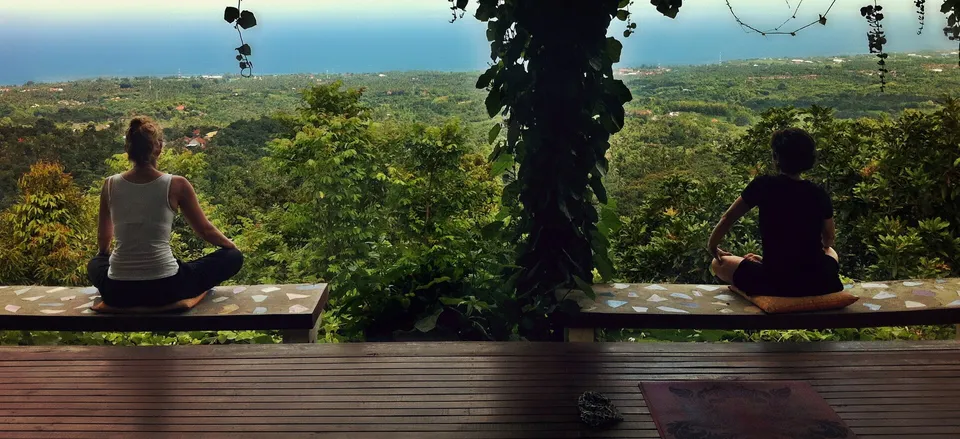
Two people seated in a contemporary open-air practice space in Bali. This photograph does not represent every tradition or yoga’s place of origin.
Yoga developed in South Asia through diverse communities and bodies of teaching. The Smithsonian’s Yoga: The Art of Transformation examines its changing meanings through texts, artworks and the lives of practitioners. Its scope includes religious goals, social identities and later global forms. A photograph of a present-day studio captures one setting within that much wider history. Smithsonian exhibition publication
Dates deserve care. Historical evidence does not establish that every class sequence has been passed down unchanged for thousands of years. James Mallinson’s Smithsonian essay describes both the value of surviving images and the uncertainty of reading later yoga practices into much older objects. It is more useful to ask what a particular text, teacher or community actually documents. Yogic identities and historical evidence
Paths describe a spiritual orientation
You may encounter bhakti, jnana, karma and raja yoga together. In the Vedanta Society’s account, bhakti emphasizes devotion, jnana knowledge and discernment, karma selfless action, and raja meditation. These terms concern spiritual life and its aims. They are not four standard sequences of postures. The society also presents the paths as capable of being combined, rather than as exclusive boxes for different kinds of people. The Vedanta Society’s four paths
This is an identifiable teaching framework, not the only way all yoga communities have classified yoga. Research into the Sivananda and Krishnamacharya schools examines how modern organizations arranged and transmitted their practices. When a contemporary course uses the four-path model, its teacher and tradition matter to the meaning. Hannah K. Bartos, Modern Transnational Yoga
You do not need to adopt a religious outlook to understand the vocabulary. Equally, describing a devotional practice solely as relaxation leaves out what practitioners understand themselves to be doing. A fair introduction names that context without asking the reader to accept its beliefs.
Eight limbs are a framework rather than a class timetable
The Yoga Sutras associated with Patanjali describe an eight-limbed discipline. Its categories include ethical restraints and observances, posture, regulation of breathing, withdrawal of the senses, concentration, meditation and absorption. Posture is one component within this philosophical framework. The Sanskrit expression ashtanga means eight-limbed. The Yoga Sutras in the Internet Encyclopedia of Philosophy
On a modern timetable, Ashtanga usually means Ashtanga Vinyasa, a particular postural system associated with twentieth-century Mysore. Naming that system precisely avoids making the older framework and the modern sequence-based school interchangeable. Their relationship can be discussed without saying that the Yoga Sutras contain today’s Primary Series.
Hatha has a broad history and a narrower timetable use
SOAS’s Hatha Yoga Project describes hatha as a medieval method in which physical practices predominate, emerging among diverse ascetic traditions around the beginning of the second millennium CE. That historical category reaches beyond the pace of a present-day class. On timetables, the same word is often used more loosely for a class that gives separate attention to postures. SOAS Hatha Yoga Project · USC class style guide
The apparent contradiction disappears once you separate history from scheduling. Several postural styles may share a hatha background, while a studio uses “Hatha” for one session and “Vinyasa” for another. Ask which sense the teacher means.
Schools and formats answer other questions
A named school, such as Iyengar, points to a particular teaching tradition and organization. Vinyasa commonly describes a class organized around linked movement, while Yin and Restorative refer to distinct approaches that can both involve a slower pace. Yoga nidra generally names a guided practice rather than a flowing posture class. The individual profiles in this collection explain these distinctions and their sources.
Other labels can be added on top. Hot describes a heated environment. Power often signals a more active contemporary class, although providers use the term differently. Chair yoga identifies a way of adapting the setup; it does not identify a single lineage or age group. A class could therefore be both vinyasa and heated, or chair-based and taught within a named school. The labels are not a set of mutually exclusive categories.
Read a name as the beginning of a description
Let the label guide your next question. Ask a named school about its teaching method; ask a flowing class how it introduces a sequence. For chair yoga, find out whether the whole session is seated. For hot yoga, check the room conditions. Each answer adds information the name alone cannot give you.
The profiles that follow describe common patterns, while leaving room for teacher and studio differences. They do not rank styles by effectiveness or decide which one is right for an individual reader.
If you are arranging a first visit, the preparation guides in Yoga for Beginners address that practical step.
From Pavel’s experience
Personal experience — Pavel Rachkouski, founder. One person’s notes, not advice.
For about 15 years I’ve practised on and off — asanas and general fitness. Whether that counts as yoga, I’m not sure: yoga isn’t only about exercises. I have mostly followed videos, and I am not certified. Looking back, for most of that time I was doing yoga as exercise. A friend who practises yoga and lives in Fethiye, Turkey, was the one who really showed me what yoga is: linking your body, your breath and your mind in one practice so they work as a single mechanism. That is genuinely hard. Even after his yoga, my own conclusion was that everyone has their own yoga, and your practice should be yours alone. A teacher can set you up and show you how to do the poses. This is my personal conclusion.
For a beginner: just put on a video and, for at least two weeks, simply repeat what it says, without any inner work; only then start adding it. It works both ways. One person needs to try first and see how it stretches the body. I would have needed someone to sit me down and show me straight away how to connect everything; it would have been hard but interesting. Yet when I was shown, I wasn’t ready to make the effort, and I came to a yoga retreat only a year or two later. Decide your goal from the start: for yourself or for someone else, and why. Many ideas get mixed up: some people practise because yoga is cool, some for poses and social media. Without a goal you won’t even roll out the mat. That is how it works for me; I don’t know how it is for others.
I’ve tried many styles, and just like with tea, I don’t remember the names. I’m for explaining to people in plain words what is going on. In some classes there is so much talk that I stop understanding why I’m being told all this when I came to practise yoga: a lot of philosophy that didn’t help me practise.
Fethiye, Turkey — photo by Pavel
Frequently asked questions
What are the main types of yoga?
On studio timetables you will often see Hatha, Vinyasa, Ashtanga Vinyasa, Iyengar, Yin, restorative and hot or power yoga. They answer different questions — lineage, teaching method, pace or setting.
What is the difference between a yoga tradition and a yoga style?
A tradition or path describes aims and teachings; a style or class format describes how a particular class is taught.
Are bhakti, jnana, karma and raja yoga types of exercise class?
No. In the Vedanta Society’s account they are spiritual paths — devotion, knowledge, selfless action and meditation — and can be combined.
Is modern yoga the same as ancient yoga?
Not exactly. Historians caution against assuming today’s class sequences were passed down unchanged; ask what a specific text or teacher documents.